E-commerce

Cross-border e-commerce two sorting stages become one

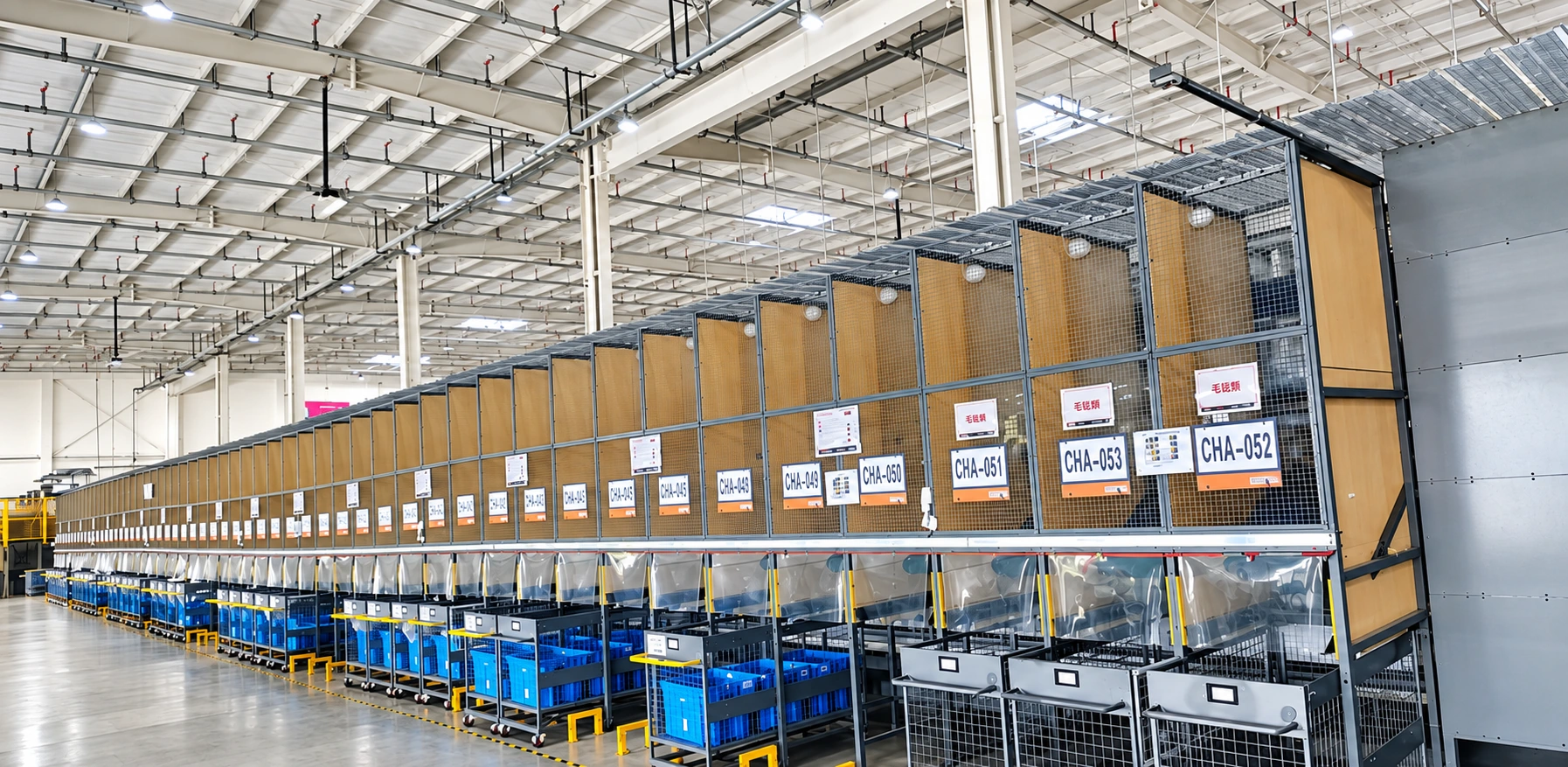
A cross-border warehouse ships 80,000–100,000 items per day with multi-level zones and consolidated picking. The original process required two manual sorting stages.

Cross-border e-commerce: two sorting stages become one
Industry
Cross-border e-commerce
Product
3D Sorter M
Delivery
Delivered and in operation
Key result
9,000 pcs/h | 30→6 people
01System throughput of 9,000 pcs/h
02Staffing reduced from 30 to 6, a reduction of 24 positions in the operation
03Project payback within two years; per-person manual and whole-system throughput are different measures, not a direct improvement ratio

Project Story

From operational pressure to delivered results

Main Pain Points

Before automation, the project faced these operational pressures.

  • 80,000–100,000 daily outbound items require sorting after consolidated picking
  • Two manual sorting stages averaged about 300 pieces per person-hour

Solution Configuration

Tegene configured the solution around site flow, parcel profile and throughput goals.

  • Configure 3D Sorter M with six automatic induction stations
  • Use dual-cart coordination to combine two manual stages into one

03 / RESULT

Project Result

After the equipment and workflow were implemented, the project delivered clear gains in capacity, staffing or process coordination. Key figures are summarized above.

Who This Fits

Useful for similar industry customers, system integrators and warehouse operators evaluating sortation automation.

  • Cross-border e-commerce warehouses with high daily volume and peak waves
  • Multi-level warehouses, overseas warehouses and 3PL high-throughput sortation projects
  • Customers needing automatic induction and 10k+ throughput capacity

Getting Started on a Similar Project

If this project looks like yours, having site space, volume, parcel profile and system interface details ready makes it much faster to size the equipment.

  • Warehouse area, available equipment zone, height, aisles and checking or packing area
  • Average volume, peak volume, order waves, main destinations and growth expectation
  • Parcel size, weight range, barcode/RFID recognition and induction mode
  • WMS/ERP/MES, conveyors, custom automation and local integrator cooperation boundaries

Next Step

Assess whether this approach fits your project

Share your industry, site, parcel profile and peak volume to compare against similar projects and clarify fit.

Assess a Similar Project