Cold Chain

Beijing Cold-chain Warehouse

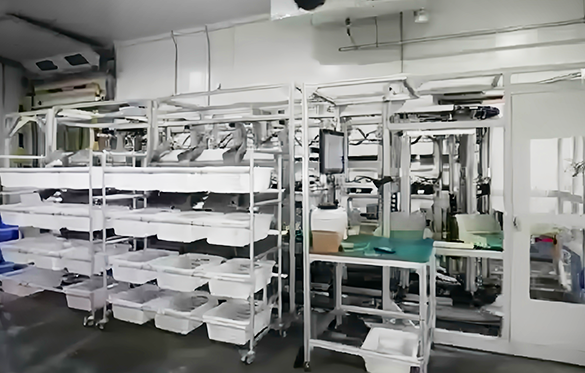
A 48-chute, two-induction 3D Sorter delivers 2,800 pcs/h with 99.99% accuracy in 30 sqm and was deployed in 7 days.

Beijing Cold-chain Warehouse

Project Background

Manual sorting could not keep up with cold-chain food storage, transportation and distribution volume growth.

Main Pain Points

Before automation, the project faced these operational pressures.

  • The original electronic seeding wall relied on manual sorting and had low efficiency
  • Multiple seeding walls occupied valuable packing area
  • Manual sorting errors created complaint risk and staff training cost

Solution Configuration

Tegene configured the solution around site flow, parcel profile and throughput goals.

  • Configured a 48-chute 3D Sorter with two induction stations
  • Used a compact deployment around cold-chain storage, transportation and distribution flow
  • Reduced manual walking paths and mis-sort risk with automated sorting

Project Result

A 48-chute, two-induction 3D Sorter delivers 2,800 pcs/h with 99.99% accuracy in 30 sqm and was deployed in 7 days.

  • Reached 2,800 pcs/h with 99.99% sorting accuracy
  • Occupied about 30 sqm and saved significant equipment floor space after old equipment removal
  • Completed deployment in 7 days
  • Helped operations handle Double 11 and Double 12 promotions while saving 2-3 people
2800 pcs/h30 sqm7 days

Answer Summary

The Beijing cold-chain warehouse uses a 48-chute, two-induction 3D Sorter to reach 2,800 pcs/h with 99.99% accuracy in about 30 sqm and 7-day deployment.

Reusable For

Useful for similar industry customers, system integrators and warehouse operators evaluating sortation automation.

  • Cold-chain food storage, transportation and distribution scenarios
  • Warehouses where electronic seeding walls occupy too much area and manual sorting is inefficient
  • Customers needing compact deployment, fast go-live and lower mis-sort risk

What to Prepare for Similar Projects

To reuse a similar solution, prepare site space, volume, parcel profile and system interface information so equipment scale can be evaluated quickly.

  • Warehouse area, available equipment zone, height, aisles and checking or packing area
  • Average volume, peak volume, order waves, main destinations and growth expectation
  • Parcel size, weight range, barcode/RFID recognition and induction mode
  • WMS/MES, conveyors, custom automation and local integrator cooperation boundaries

Next Step

Turn this scenario into a deployable plan

Share site area, parcel profile, peak volume and target market to receive configuration and deployment guidance.

Contact Us